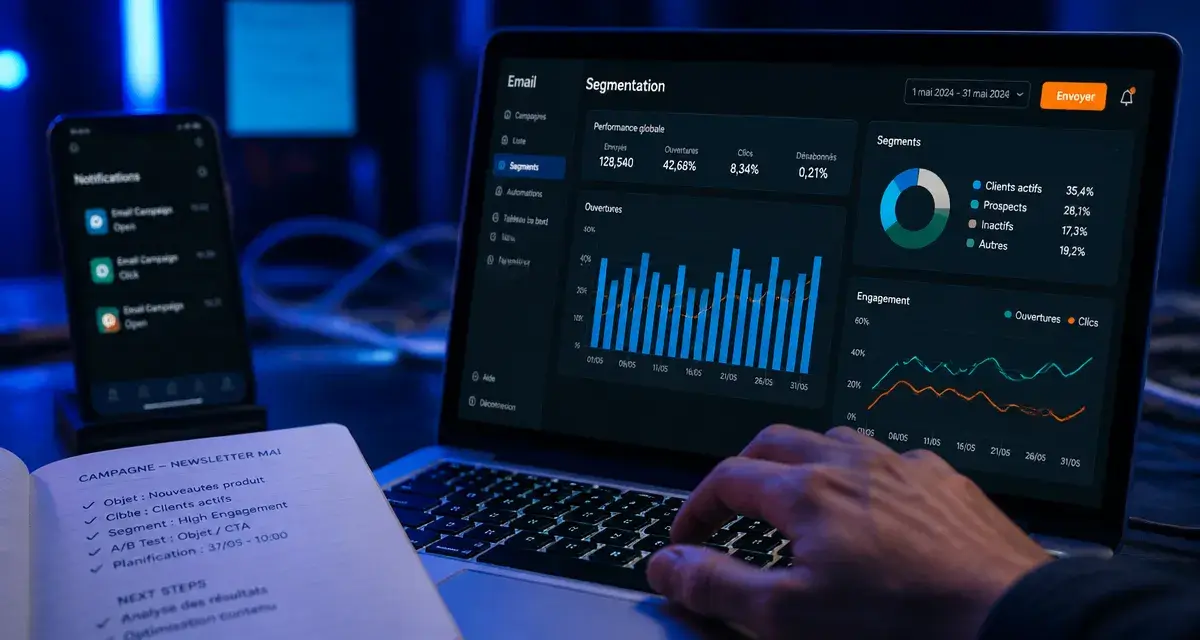
Data driven email marketing uses real customer signals to decide who receives an email, what they see, when they receive it, and how success is measured. Instead of sending the same newsletter to everyone and hoping for clicks, the campaign is shaped by opens, clicks, scrolls, purchases, website behavior, and engagement patterns.
This approach matters because inbox attention is limited. Televerde notes that the average professional sorts through more than 100 emails every day, so generic messages are easy to ignore or delete. The case for email is still strong, though: Acxiom reports that email marketing can return $36 to $42 for every $1 invested. The gap between wasted volume and profitable email often comes down to how well the data is used.
What makes email marketing truly data driven?
A data-driven email strategy is not just adding a first name to a subject line. It is a decision system. Customer data influences the audience, the offer, the message, the timing, the follow-up, and the reporting. The campaign is built around what people have done, not what the team assumes they might want.
Traditional campaigns vs data-informed campaigns
Traditional mass emailing usually starts with the message, then looks for a list to match it. Data driven email marketing starts with the audience: which subscribers have shown intent, what they are interested in, and what action should happen next. That shift turns email from a broadcasting channel into a guided customer journey. It also gives marketers a cleaner way to decide whether a message belongs in an inbox at all.
| Approach | How it works | Typical risk |
|---|---|---|
| Spray and pray | Same email, same timing, broad audience | Low relevance, weak engagement, poor brand perception |
| Data driven | Segmented audience, personalized content, behavior-based timing | Requires clean data, clear rules, and consistent measurement |
The core promise: the right message at the right time
The goal is simple but demanding: send the right message to the right audience at the right time. A new lead who downloaded a comparison sheet does not need the same email as a loyal customer who bought twice last month. A subscriber who clicks pricing content is showing different intent from someone who only opens educational newsletters. Data helps marketers recognize those differences and respond with content that fits the moment.
The customer data worth collecting before you automate anything
Automation works only when the inputs are useful. Before building complex workflows, marketers need to decide which data points are reliable, legal to use, and tied to a real campaign decision. Collecting more data is not automatically better. Collecting actionable data is what matters.
Four practical data families
The most useful email data usually falls into four groups. Demographic data helps adapt messaging by role, location, company size, or age group when it is relevant. Purchase history reveals what someone has bought, how often they buy, and what they may need next. Website behavior shows interest through page visits, product views, content downloads, or pricing-page activity. Email engagement patterns show who opens, clicks, scrolls, ignores, or converts after a campaign.
| Data type | Email use case | KPI to watch |
|---|---|---|
| Purchase history | Cross-sell, replenishment, loyalty campaigns | Conversions, revenue, repeat purchase |
| Website behavior | Intent-based nurturing and product education | Click-through rate, pipeline progression |
| Email engagement | Reactivation, send-time optimization, content testing | Open rate, clicks, unsubscribes |
| Demographics or firmographics | Segmented messaging by audience profile | Engagement, conversion rate by segment |
Collect data legally and transparently
Legal collection is not a technical afterthought. Use clear opt-in forms, explain what subscribers are signing up for, keep consent records where your platform allows it, and make unsubscribing easy. Preference centers are useful because they let people choose topics, frequency, or product interests instead of leaving the list entirely. Responsible data use protects deliverability, trust, and long-term performance.
Think of data like fabric on a cutting table. The quality of the finished garment depends on where you cut. A tailor using shears does not slice randomly; they follow the grain, avoid weak spots, and remove excess with intention. Email teams should treat segmentation the same way. Do not split the list into arbitrary pieces just because the platform allows it. Cut along meaningful lines, such as recent intent, product interest, buying stage, engagement depth, and preferred timing. Clean cuts create campaigns that fit. Careless cuts create fragments too small or too vague to act on.
How to turn data into segmentation, personalization and automation
Once the right data is available, the next step is activation. This is where many teams overcomplicate the process. You do not need dozens of segments on day one. Start with a few segments that reflect clear differences in customer need, then build personalized content and automation around those differences.
Segmentation that changes the message
A segment is only useful if it changes what you send. An ecommerce brand might separate first-time buyers, repeat buyers, and inactive customers. A B2B software company might segment by lifecycle stage, such as new lead, product evaluator, opportunity, customer, and expansion candidate. A publisher might group subscribers by topics clicked in the last 60 days. Each segment should have a different reason to receive an email, and that reason should be visible in the message itself.
Personalization beyond the first name
Strong personalization adapts the substance of the email. That can mean recommending products based on purchase history, changing the call to action based on funnel stage, highlighting a case study for the subscriber’s industry, or sending educational content after someone visits a beginner-level resource. Subject lines and send times can also be influenced by data, but the biggest gains often come from making the offer itself more relevant.
Automation as a response to behavior
Automation works best when it reacts to meaningful signals. A click on a product category can trigger a comparison email. A pricing-page visit can trigger a sales-oriented nurture sequence. A long period without opens can trigger a re-engagement campaign or suppress future sends. The point is not to automate more emails. It is to automate more appropriate next steps, based on what the subscriber actually did.
The KPIs that show whether your strategy is working
Data driven email marketers need metrics that connect attention, action, and business value. Open rate can show whether subject lines and sender trust are working, but it cannot prove success alone. Click-through rate reveals whether the content drives action. Conversions show whether the email helped generate the intended outcome, such as a purchase, demo request, or pipeline movement.
Track both engagement and business outcomes
A practical dashboard should include open rate, click-through rate, conversions, unsubscribe rate, revenue or pipeline influenced, and ROI. Engagement metrics help diagnose the campaign experience; business metrics show whether the campaign was worth sending. HubSpot’s Marketing Industry Trends Report found that 31% of marketers say data-driven strategies primarily help them understand campaign effectiveness, which is exactly why reporting must go beyond vanity metrics.
Read metrics by segment, not only in aggregate
Average campaign performance can hide important patterns. A subject line may perform poorly overall but work extremely well for a high-intent segment. A Thursday morning send time may be strong for one audience and weak for another. Compare engagement patterns across audience groups, lifecycle stages, and time-based behaviors so optimization decisions do not flatten valuable differences. The segment view often explains what the average hides.
A practical workflow for continuous optimization
Data driven email marketing is not a one-time setup. It is a loop: collect data, analyze behavior, segment the audience, personalize the campaign, automate where useful, measure performance, and adjust. The faster this loop runs, the easier it becomes to improve campaigns in near real time. That is where the method becomes more than a reporting exercise.
Start with one campaign and one hypothesis
Choose a campaign with a clear goal, such as reactivating inactive subscribers or converting product-page visitors. Form a simple hypothesis: subscribers who clicked product content in the last 30 days will respond better to a comparison email than to a generic newsletter. Build the segment, send the campaign, track the result, and compare it with a broader audience or a previous baseline.
Improve without over-personalizing
More personalization is not always better. If an email feels invasive, uses sensitive assumptions, or references behavior too explicitly, it can damage trust. Use data to be helpful, not creepy. A message like “Based on your interest in analytics, here are three ways to improve reporting” usually feels useful. A message that names every page someone visited may feel excessive and create the wrong impression.
Keep your list healthy
List hygiene is part of performance. Suppress consistently inactive contacts, remove invalid addresses when your platform identifies them, and watch unsubscribe or complaint patterns after each campaign. Clean data improves segmentation, protects deliverability, and prevents teams from making decisions based on distorted engagement numbers. It also keeps reporting honest, which matters when campaign decisions depend on the numbers.
The best data driven email marketing programs are not the ones with the most dashboards or the most automation. They are the ones that use customer insights to make better choices consistently: who to contact, what to say, when to send, what to measure, and what to change next.

Articles qui pourraient vous intéresser :
 Branding astral : donner une dimension céleste à votre image de marque
 Expertiseo.fr : tout comprendre sur ce cabinet d’expertise comptable en ligne
 Les meilleures marques en D : panorama, critères et sélection d’excellence
 Avis Google : Comment consulter, gérer et optimiser la réputation de votre établissement